

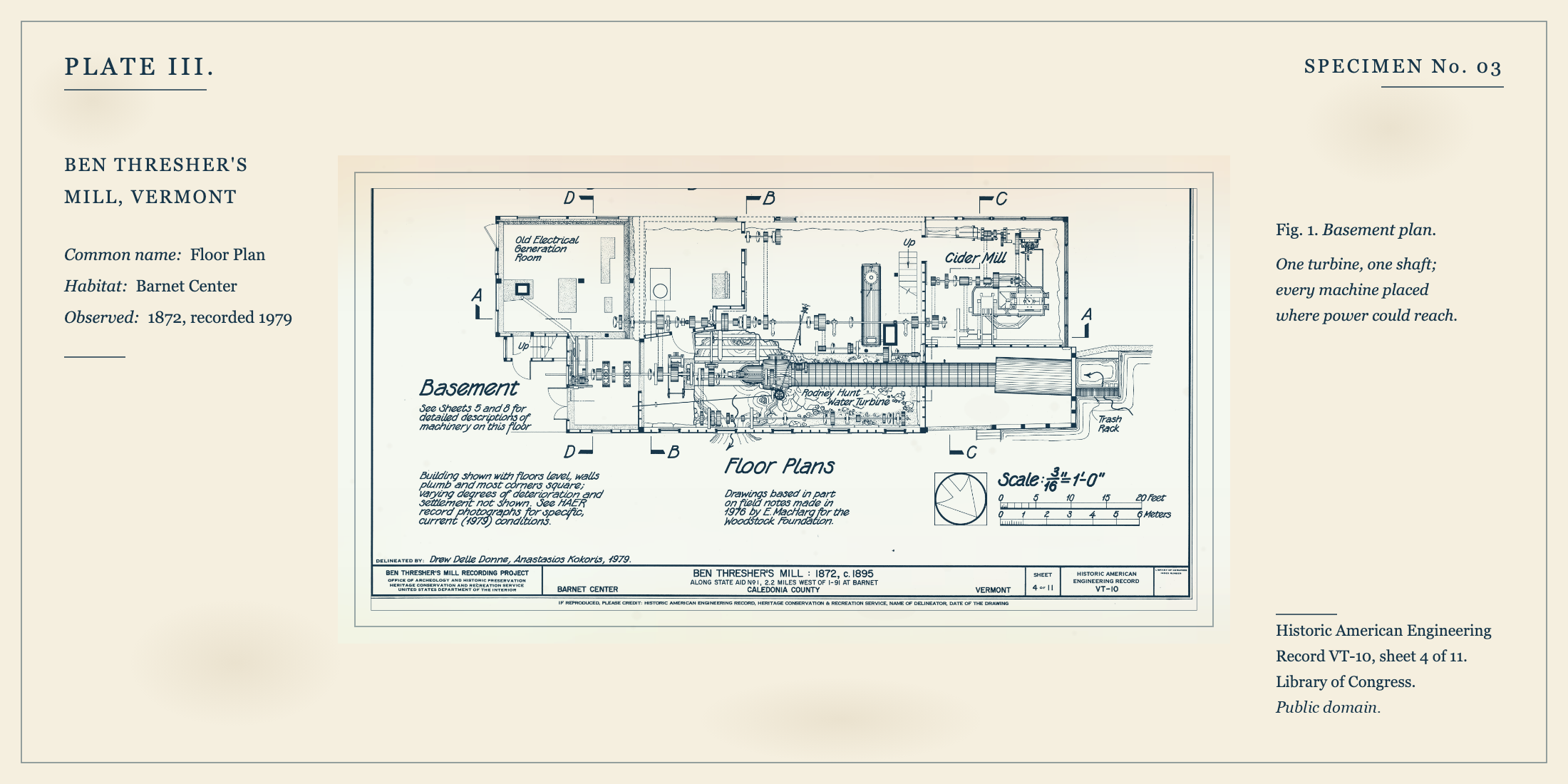
The story of electrification is usually told as a better technology replacing an inferior one. The electric motor arrives, the steam engine retires, the factory runs cleaner and faster. That version is tidy but it is also incomplete. The electric motor was available for decades before it produced anything resembling a productivity revolution. Understanding that delay, more than thirty years, is the most useful thing this history offers, because the same gap between capability and payoff appears to be opening again with AI.
The Steam Factory
In the late 1800s a factory was organized around its power source. One large steam engine turned a central driveshaft that ran the length of the building with belts and pulleys dropped off that shaft to drive each machine. Because power degraded with distance from the shaft, machines had to be clustered tightly around it, and buildings were often built tall and narrow to keep the shaft short. The architecture of the factory was dictated not by how work flowed but by how power could be distributed.
The Electric Motor Arrives
When electric motors became available, most owners did the obvious thing: they pulled out the steam engine and dropped a single large electric motor in its place, turning the same driveshaft. The factory ran cleaner, maintenance costs fell, and there were real efficiency gains. But the building was unchanged, the machines still clustered around the shaft, the layout still reflected the obsolete constraint, and the productivity revolution did not materialize. The technology had changed but the architecture of the system had not. Mere substitution is the trap. A new source of power bolted into an old design produces a better version of the old factory, not a fundamentally different one.
The Unit Drive
The breakthrough was not the motor. It was the unit drive, a separate, small motor on each machine. Once every machine carried its own motor, the central shaft became unnecessary, and the constraint it imposed dissolved. Machines no longer had to sit near the shaft; they could be placed wherever the work wanted them. Factories were rebuilt around the flow of production, single-story plants laid out in sequence, materials moving in a line, overhead cranes where the driveshaft used to be. Henry Ford†'s moving assembly line was the most famous of these redesigns. Machines and workers stood in the order the work required rather than the order a driveshaft would have allowed, and a Model T that cost $850 in 1908 sold for under $300 by the mid-1920s. Only after the process was redesigned did productivity accelerate, in the 1920s, decades after the motor itself had arrived. The motor was necessary. The redesign created the value. It wasn't the motor, it was the floor plan.
The technology had changed but the architecture of the system had not. Mere substitution is the trap.
One Worker, Many Engines
The traditional corporation is a steam factory. It is built around thinking as the constraint. One person can run only so many processes, produce only so much output, and make only so many decisions. More output requires more people. Much of the modern firm, its layers, departments, workflows, approvals, and headcount, reflects that assumption.
Most AI deployment today is the electric motor on the old driveshaft. It's substitution, one associate and a copilot; one analyst and a chatbot; one engineer and a coding assistant. It is genuinely helpful, it is incremental, and it leaves the structure intact, a better power source in the old design.
What the historical example of electrification reveals is that the reorganization, whatever form it took, was where the value landed, not the motor itself. The real parallel to the unit drive may not be the AI assistant but the semi-autonomous agent. Instead of one person with one assistant, one person directs many specialized agents at once, research, analysis, drafting, monitoring, each working independently, each carrying part of the cognitive load in parallel. The gain is not "one agent replaces one worker" or "one assistant helps each employee." The gain is that one worker gains access to many parallel cognitive engines, the way one factory gained access to many independent sources of power.
As with the factory, the largest gains arrive only when the organization is redesigned around the new capability. That redesign is easier to imagine than to implement. The first firms to reorganize around AI may not look like firms with better employees. They may look like firms with fewer seams, fewer handoffs, fewer queues, and less distance between a decision and the action it sets off, because the work no longer has to be carved into pieces small enough for a single person to carry. When work is rebuilt on that assumption, the organization itself begins to change. The result is organization with a different shape, not just faster outputs.
The motor was necessary. The redesign created the value.
Why It Lags
This is why the productivity payoff trails the capability, and why it will likely keep trailing it for a while. Even when capability is available, the redesign is slow, uneven, and easy to miss if you are watching the wrong signal. At this point adoption is the wrong signal. Every firm will soon be able to say it uses AI, the way every factory could eventually say it had an electric motor. What shows a transition turning productive is reorganization: the shape of the work changing, not the tools inside the old shape. By that test, most firms are still just swapping out the steam engine. The companies that ultimately capture the most value from AI, then, may not be the companies building AI. They may be the companies that reorganize themselves around it first. It wasn't the motor, it was the floor plan. In this transition too, the capability may matter less than what can be built on top of it.
Which raises the question that the electric motor and artificial intelligence leave unanswered: if a technology can be right for decades before it fully pays off, how is an investor supposed to participate along the way?