

Every technological transition creates the same temptation. Once we become convinced the future is real, we start looking for the answer. The winning company. The winning technology. The winning trade. The moment the uncertainty ends.
The railroad network was real. The people who captured its value changed. Electrification was real. The productivity arrived decades after the motor. The internet was real. Being right about it did not tell you which companies would win, when they would win, or what price was too much to pay. In other words, being right about the end was not enough to navigate the journey. The lesson is not that the future is unknowable. It is that the future does not arrive all at once. It arrives in stages, and each stage asks a different question.
When railroads were being built, the question was who supplied the steel and who was contracted to put down the lines. After they were built, the question became who could reorganize commerce around them and use the network to revolutionize their industry. In the dot-com era, the question was who could commercialize the internet. After it matured, the question became which businesses could use it to create entirely new models of business. The correct answer changed because the question changed.
Investors struggle during transitions because they mistake a correct answer for a permanent one. The company that benefits most from the first stage is rarely the company that benefits most from the last. The challenge is not predicting the final winner on day one. The challenge is recognizing when the question itself has changed.
That realization is where any workable approach to AI has to begin. The objective is not to identify a single company and hold it forever on the assumption that the future belongs to it. The objective is to understand the system being built and adapt as it evolves. A prediction says the future will unfold a particular way. A map helps you understand where you are when it doesn't.
Investors struggle during transitions because they mistake a correct answer for a permanent one.
What the Map Actually Does
Let me make that concrete, because "follow the value as it moves" is easy to say and easy to nod at, and neither the saying nor the nodding is the work.
Start with the word everyone already agrees on: indispensable. The marquee chipmaker sits in nearly every portfolio because it is indispensable, every AI system runs through it. True. But indispensable turns out to mean two different things, and a portfolio that can't tell them apart will own one and underweight the other.
There is the indispensable everyone can see. It is large. It sits in every index at full weight. Its importance is already in its price. You are paid very little to hold something the whole market agrees is essential. And some of that prominence belongs to the current architecture, a particular way of training, a particular software moat, which the next stage can route around even as demand keeps climbing.
Then there is the indispensable that is harder to see and harder to bypass, not because the market agrees, but because physics does. The machine that etches the circuits is built by one or two firms on earth, and nothing else can do what it does. The heat the chips throw off has to go somewhere, and moving it is a physical problem, not a software one. You cannot update your way out of needing either. Every winner, and every winner not yet built, has to run through that layer. And because it is smaller than the marquee names, an index holds it at a fraction of its structural weight.
Which is why the work is not picking the winner, and not even holding today's answer forever. It is understanding the system deeply enough to see where the constraint sits now, and where it is migrating next, so the portfolio moves with the structure instead of staying married to whatever paid last cycle.
What the Map Prevents
Investors rarely lose money because they identified the wrong trend. They lose it because they stay loyal to the answer that worked in the previous stage, or bail before their trend is validated. The railroad investor who never left the operators. The factory owner who bought the motor but never redesigned the floor plan. The dot-com investor who was right about the internet and wrong about companies with real earnings. None of them missed the trend. They held the answer from the stage that rewarded them and kept holding it after the value had moved on. That is the error a map is built to prevent.
A prediction says the future will unfold a particular way. A map helps you understand where you are when it doesn't.
Why a System, Not a Stock
There is a structural reason this is hard to do from an ordinary portfolio. Most portfolios, and the indexes they track, are organized by sector. Semiconductors in one box, utilities in another, industrials in a third. But technological transitions travel along the economic value chain, crossing those boundaries as the constraint moves. A portfolio sorted by sector is built along the one axis the migration ignores, able to hold every right piece and still miss the way value moves between them.
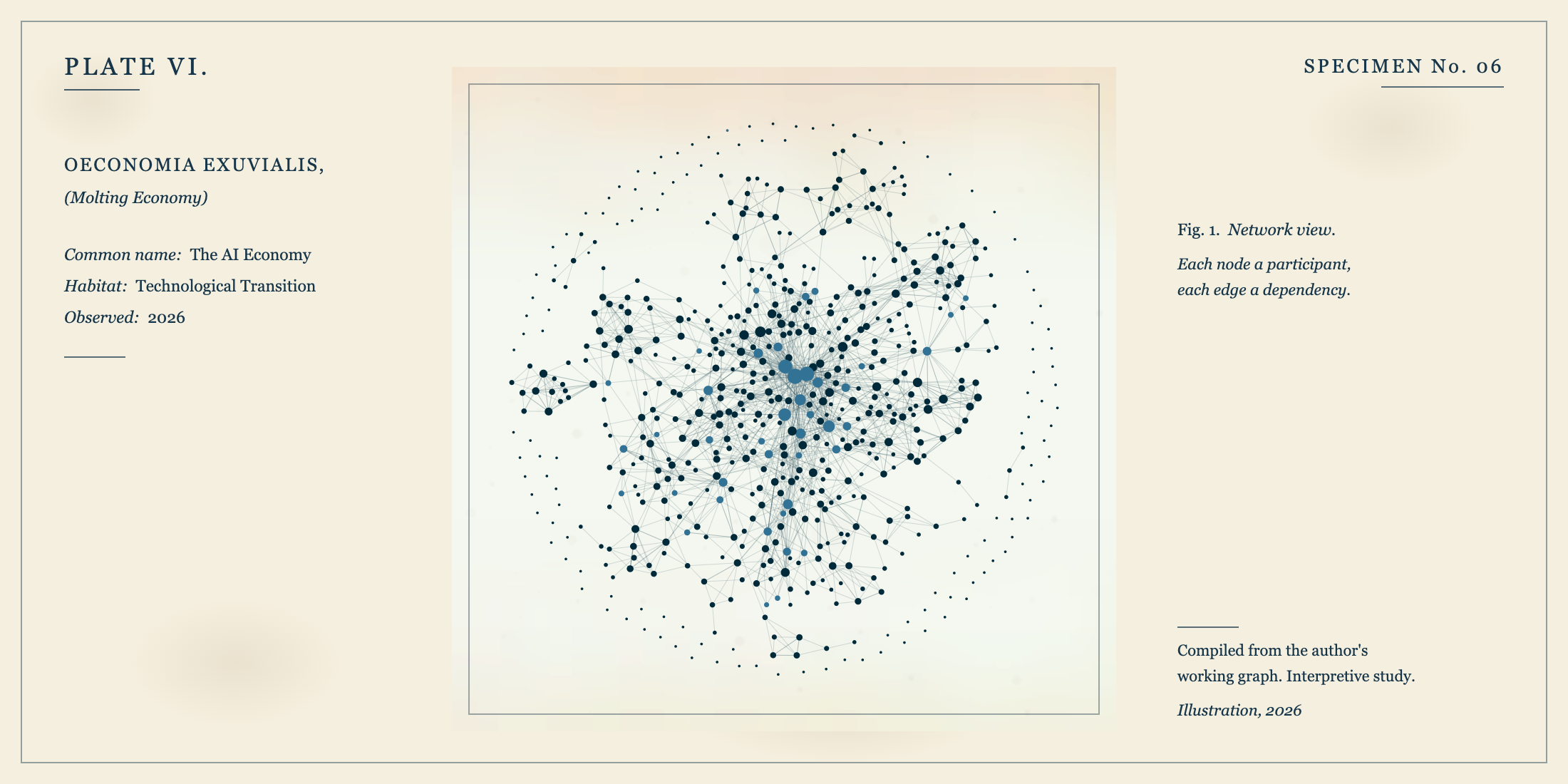
The AI Value Chain framework was built for that purpose, not to predict where the future ends, but to recognize where value is gathering now, and to notice when it starts to move, so the portfolio can adapt as the structure evolves, holding to the question rather than to any single answer it produces along the way. It begins with a simple observation. Artificial intelligence is not a single industry. It is an interconnected economic system. Semiconductors, networking, data centers, power infrastructure, software, automation, enterprise adoption, these are not separate stories. They are parts of the same story, and value moves between them over time.
Everything in the five essays before this point has pushed in one direction: the destination is rarely where investors come undone. The route is.
This series has watched value make the same migration before, in the railroad era, with a version of that same arc running through electrification and the internet. The place to stand kept moving. AI appears to be following the same pattern. The early-stage winners have been visible enough to feel like the whole story, and owning them has been profitable, which makes it tempting to read that as having bought the future. But that is only the answer to the first question, and transitions rarely stop after the first stage. Builders give way to beneficiaries; capability gives way to reorganization; the leaders at the start are not always the ones at the end.
The map will not tell you the answer. It tells you where you can look when the question changes.
The discipline is not certainty. It is orientation.